What does this mean? Who knows... If you're puzzled, you're certainly not alone.
January 10-11: A light-blue sky
of Mars shown during a NASA news conference
(Jan. 10). I guess if the NASA guys don't make a big deal of the shifting
colors of Mars, the media won't find it strange either. If this keeps up,
Earth-like Mars images will become 'normal' rather quickly.

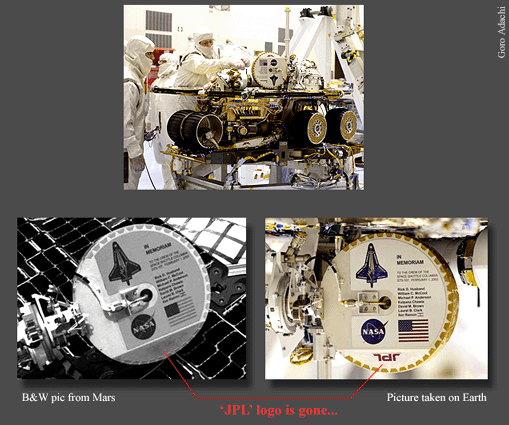
January 12: NASA released
a 360-degree panoramic picture of the Martian surface. Well, it's still
very red and the sundial area has been rather conveniently cut
out from this photo.

January 13: On January 11,
Keith Laney (a photo-processing expert) posted his carefully
processed Spirit picture from Mars which he believes shows the true colors
of Mars. In an online forum he gave us the following information:
Making sense of the
Pancam and color
looking into this, we
can see that actually the Pancam isn't true color, but it is close, a
lot closer than Ody [Odyssey?]. Not that the representations we're
seeing are correct.
"What!?!? not true color! exactly what do you mean mr. Laney?"
well, it is in sorts, but it isn't "true" because color
response is actually varied depending on observer and other factors such
as lighting and atmosphere. We all know that "true" RGB
wavelengths are something that cannot be nailed down to a definite
value, the response is more a curve. average response for RGB is a given
however, and these values are..
Red 650nm+/-
Green 510nm+/-
Blue 440nm+/-
Now we get to the Pancam, which is a remarkable piece of imaging
technology, and very complex. It has two "eyes", left and
right. they both see differently. Here are the filter positions.
LEFT CAMERA RIGHT CAMERA
L1. EMPTY R1. 430 (SP) *
L2. 750 (20) R2. 750 (20)
L3. 670 (20) R3. 800 (20)
L4. 600 (20) R4. 860 (25)
L5. 530 (20) R5. 900 (25)
L6. 480 (25) R6. 930 (30)
L7. 430 (SP)* R7. 980 (LP)*
L8. 440 Solar ND R8. 880 Solar ND
SP means short pass filter, LP means long pass filter. one lens on each
side is coated so it can observe the sun (solar ND) L1 is clear, no
filter
Using this chart for reference we see that the left eye is of main use
for color imaging, with values covering acceptable rgb values. This
means that in order for meaningful evaluation of the color or infrared
combinations produced from these images to we will have to have them
displayed so that we can obtain all the bands, and in more than
compressed jpeg. which doesn't seem to be the case
until then, we have to "trust 'em". which is not imaging or
science.
[...] a vitally
important point of [this is] that it is ENTIRELY possible for us to get
unquestionably true color images out of this thing. I'm looking for more
full left side imagery right now, and it will be very soon that I'm
fixing to show you what Spirit says is the no crap about it true colors
of this area. I just happen to have the answer for this shell game
played with spectral bands.
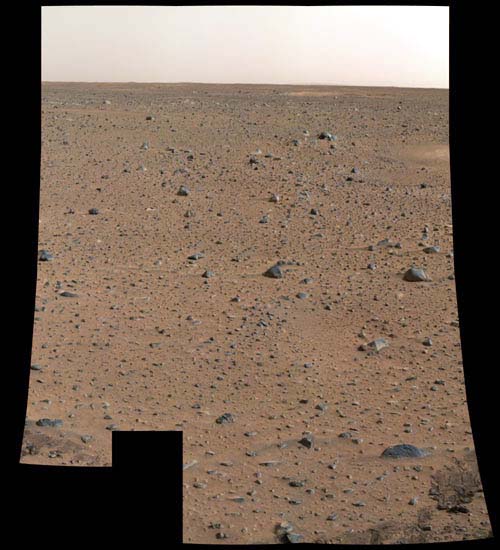
And a little later Laney revealed
his 'image showing 'Mars in true as you can get it color', adding 'It's an
exciting day!'. Here it is. (Go to www.keithlaney.com/spirit_color_images.htm
for more.)

This is very
different from NASA's version, that's for sure... Very Earth-like. Is this
the real Mars?
January 14: The New York
Times has a little piece
(titled 'Sure, It May Look Like Mars') discussing the growing
'conspiracy theory' concerning the poor-quality/manipulated images of Mars...
Typical commentary from the mainstream press. (Thought not directly
related, it may be instructive to
read 'Paranoid
Shift', an article about propaganda and 'conspiracy theories' these
days...)
January 16: Keith
Laney has posted additional information on how to 'correct' the
NASA/Spirit pictures (see here).
He comments:
...the
huge, hastily constructed pans with the ruddy color, stitch lines, and
beige sky do not do justice to the actual beauty of the Martian surface.
I offer an alternative view, one done with a fair degree of accuracy
using common and measurable techniques. One which shows Mars may be more
than we ever imagined. Two Worlds, One Sun.
January 19: Over at the ATSNN
website there is a very detailed page
explaining that the Spirit picture anomalies are actually not
really a
result of NASA manipulating the colors of Mars. It is probably too technical
for most people (including me), but the explanation put forward there at
least appears to make a good point. We are of course left wanting
to see a counter-argument from the other side... and we do have this quick
response from Keith Laney {slightly edited for smoother reading):
I see some instant
errors in that [explanation], though he does go at length to describe
the process pretty well. A lot of the stuff he references I've also
referenced to do the images. L4, 5, and L6 are definitely NOT RGB, but
do make the tabs on the cal dial correct. If it is true what he's saying
here then the red shift into the blue in "true" color would
cause actual real color images to have a violet blue tab with the other
color tabs basically correct.. which is what I've got on mine. We'll
study this more. You could not get correct color with 2,5, and 6
either..
somewhat, but off.
What is more
important is centering the bandwidths with the images given, which he
doesn't seem to cover.
I really don't see how he comes to an innocent conclusion for the
reasons why the Pan releases are so red either, it's just not right.
And so... that's where
we are on this matter at this time. More updates coming as/if this
development further.
January 21: With the title 'More
Proof Mars Has Blue Skies', this picture from Viking 2 Lander
(1979) was posted
on Rense.com (validity unclear):

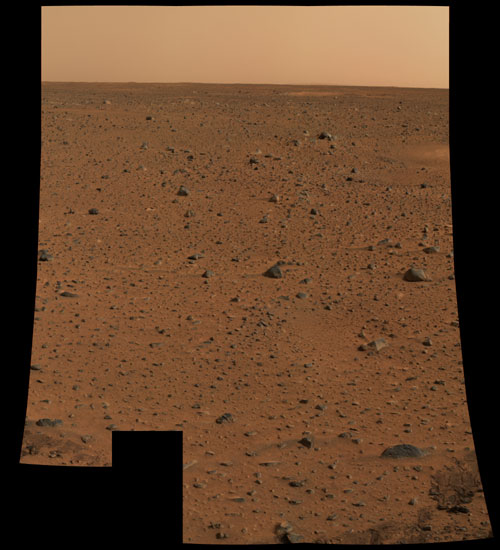
January 22: A striking picture
shown below was just released
by NASA. The caption states it "shows
the rover's landing site, the Columbia Memorial Station, at Gusev Crater,
Mars. This spectacular view may encapsulate Spirit's entire journey, from
lander to its possible final destination toward the east hills."
This image is remarkable in that it
finally shows, clearly and fully, both the Martian landscape/sky
and the landing vehicle. This combination would represent less room for
hiding potential color imprecision/anomalies/manipulation. And NASA/JPL
appears to be well aware of this situation, as the caption put under the
picture includes this note: "Data from the panoramic camera's
green, blue and infrared filters were combined to create this approximate
true color image." Hmm... An 'approximate true color image'.
That's an interesting phrase.

More intriguing is this BBC news article
about the same Spirit picture. As far as I'm aware, it is the first
mainstream hard news article to directly address the puzzling color issue
of Spirit/Mars. Here are some excerpts from the article:
- "Colours in the image have been
adjusted but scientists have not yet determined the "true"
colour of the Martian rocks."
- "Nasa scientists have used the colour
calibration target, also known as the sundial, to adjust the image so that
its hue is a close approximation of the colour of the Martian surface."
- "However, mission scientists will
have to perform further calculations before they can produce an image that
shows Mars' 'true' colour."
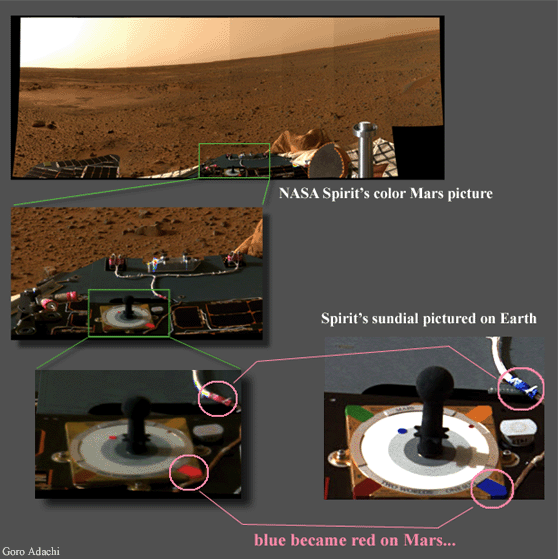
- "...the image shows signs of
the correction process to get the colour of the Martian surface as close
as possible to its true colour. The normally blue starscape - or
"meatball" - that forms the Nasa logo has turned a muddy red.
And blue insulating foam surrounding cables on the lander has turned
bright pink."

Is it just me or is
there an aura of 'non-denial denial' and/or 'non-admission admission'
emerging with this development? They seem to want to leave the impression
that the colors of the Mars pictures are more or less accurate. And yet
they also now carefully point out that we don't yet have the 'true color
of Mars'.
Personally, I'm still
seriously considering my original model... i.e. that there is a gradual
politically-motivated 'disclosure' (or trickery) taking place, designed at
least in part to get the public more interested in space exploration, so
that space exploitation and miniaturization can be
implemented just as called for by the hidden neo-conservative/PNAC
agenda
driving the Bush administration. There could be various other issues
involved as well, of course.
Update: Today it is being reported
that a 'serious anomaly' has made the Spirit rover 'go quiet'. Or in other
words, it may be gone for good. If that's the case, then the 'disclosure'
model would no longer apply for now (don't forget Opportunity that
is about to land on Mars). Let's see... Spirit lands flawlessly on Mars
at the beginning of January; Pres. Bush triumphantly announces his plan to
get man back on the Moon and then to Mars; Spirit finds a lot of anomalous
rocks and people are closely monitoring the 'shifting colors' of Mars;
polls show Americans do not welcome Bush's space initiative; Bush doesn't
even mention space exploration in his State of the Union speech on Jan.
20; and then Spirit goes down... Let's wait and see where this story goes
next.
January 23: We have another
news article
(Australia's Herald Sun) that touches on
the Mars color issue. It concludes with the following sentences:
NASA has also revealed it colour-balanced
panoramic photographs sent from the lander to approximate what a person
might see on the Martian surface.
This has raised questions about
whether the landscape is really red.
It appears the issue is becoming
more mainstream now. Could this be part of the reason why Spirit
'went silent'? Here is an excerpt from a message sent to a 'Cydonia' email
discussion forum that gives us further evidence that there was increasing
pressure on NASA to produce the real color of Mars:
From: ---
Date: Thu, 22 Jan 2004 08:58:21 -0000
Subject: [cydonia] Not So Timid Press Questions
Several of yesterday's
postings complained about the press being timid about their questions.
Well, I saw part of the C-Span coverage of the briefing (Jan 21). Many
of the reporters asked "tough" questions in regards to the
"true color" issue, including Chandler (spelling?) from New
Scientist. One reporter asked something like "Why is it called the
red planet if [parts of] it is blue?" There were perhaps 2-6
minutes of give and take between several reporters and a JPL team member
about the issue of "true color". Basically, JPL/NASA said that
they were in a hurry to get "something" out to the folks, and
that real true color processing will probably take about 2 weeks or so.
And now Spirit is suddenly
silent... But it's not yet completely dead, and Opportunity is arriving
there soon, so the game is not over yet.
January 29: Well, Spirit seems
to be recovering at this time, and Opportunity has successfully landed on
Mars, already giving us more pictures of the not-so Red Planet. Here is
one, processed
by Keith Laney, showing Mars in its likely true colors.

Today another
mainstream news article
appeared in the UK that directly addressed the Mars color issue. Slowly,
but this subject appears to be gaining some momentum.
Nasa
accused of painting Mars red
By Robert Uhlig, Technology Correspondent (Filed:
29/01/2004)
The American space
agency Nasa has been accused of doctoring its
pictures of Mars to make the Martian surface conform to our
impression of the famously red planet.
Nasa has been
accused of digitally "tweaking" drab brown scenery to make it
redder. It has even been suggested that Nasa removed green patches to
hide evidence of life.
The theories gained
credence after Nasa told New Scientist that "getting the colours
right is a surprisingly difficult and subjective job", the magazine
reports today.
Most of the pictures
have been taken through green, blue and infra-red filters - instead of
green, blue and standard red filters, which would have produced more
accurate colours.
Dr Jim Bell, who
worked with Nasa on the Mars rovers' cameras, said infrared filters were
used because they helped geologists to distinguish rock types.
In reality, Mars
appears red largely because of the dust in its atmosphere.
This article is a
little strange in that it fails to mention the source of the accusation.
Well, I guess they didn't want to say 'those crazy websites on the net
could be right after all...' :) And the last sentence is curious in
that while seemingly leaving the impression that Mars is red in
reality, that's not quite what it's saying. It's actually stating that
when there is a lot of dust in the Martian atmosphere, we'd see more red
on the surface and in the sky. And the amount of atmospheric dust depends
on the Martian weather. In other words, the sentence could easily be
interpreted to mean 'Mars is normally not that red'.
February
1: Here is an interesting one from
Hoagland/Enterprise
Mission. Pretty much self-explanatory... Could be evidence of color
manipulation? We'll see.

UPDATE: The
'NASA color' image above (left) was actually in grayscale/B&W
originally. The color was manually added later by Don
Davis who writes:
A prominent web site
[i.e. Enterprise Mission] known for unconventional expressions has
appropriated this image and used it with a caption suggesting it is a NASA
image. It is not, it is my mosaic of several THEMIS and MGS images I
fitted together in between my paying jobs.
Further info from elsewhere
('The Bad Astronomer'):
...I
talked at length with artist Don Davis, who made it clear what is going
on. [...] Don does not work for
NASA. The original data come from NASA, but the color processing was not
done by NASA. [...] He... colorized the image by
hand, using the multicolor imagery as a guide. He has decades of
experience in color and art, and feels that the color is as
"reasonably close" to reality as he can get it. Even though it
is colorized, he tried very hard to keep the tonal distribution correct.
As
for the green color shown in the Mars Express image, the same states:
...we
know from spectral analysis that
the rock is basalt. We also know that basaltic rock is not green! Clearly,
the images are not properly calibrated for color and tone balance. Don
went as far to say "I would bet money that the dark areas are not
green." Basically, when taking three images using different filters
and combining them, you have to be very
careful about color balance. [...] I have sent email to several scientists
about the Mars Express image, and I hope to get a clear response about the
color calibration.
So
it appears that this particular claim [or at least inference] of Hoagland/TEM may not be valid.
Still, the green color in the Mars Express image is really there in the
original photo, and it would be very interesting to see if this too may a
product of the annoyingly delicate calibration process. Already, however,
we have this
quote from Michael McKay,
Flight Operations Director of European Space Agency, regarding the
apparent greenness of Spirit's landing site:
...certainly
like the green in the Gusev crater picture or by looking at the
development of darker spots toward the South Pole which are tied to
seasonal variations, it certainly gives rise to the speculation that
there could be algae.
So from this we could
perhaps infer that Mars Express is not suffering
from the color 'instability' phenomenon plaguing the American
counterparts.
At least the director of ESA doesn't seem worried about the color being
incorrect.
February 2: Asked
by Linda Moulton Howe in an interview,
Jean-Loup Bertaux, Ph.D. (Director
of Research, Service d'Aeronomie du CNRS, Verrieres-le-Buisson, France)
stated the following concerning the true color of the Martian sky:
...I
think it is a very important question. And in fact it is not a
triviality. I think it should be asked to NASA: is this the true
color (of the sky)? I think it is very important. The sky color
might change with the quantity of dust particles in the air. Sometimes
they may be red or less red, depending upon mainly the size of the dust
particles. There might be a lot of very fine dust grains that might have
a slightly different color from the big grains, I would say. So, the
question is not trivial. It is important and it is interesting that
the public is asking such a question.
As I said before, this
issue is gaining momentum...
February 5: We find two
more articles, both published on Jan. 28, dealing with the Mars color issue.
Here is one
from Ananova, titled 'NASA denies "sexing up" Mars
images':
US space scientists have defended
themselves against allegations that they tampered with images of Mars.
The claim is that Nasa experts "tweaked" pictures sent back by
the two Mars rovers to make it redder. [...]
Nasa said this was due to the
photos being taken through green, blue and infrared - rather than red -
filters. When infrared images were printed as red, the results were
fairly accurate but with some glaring exceptions. Blue and green, found
on the spacecraft but nowhere on the Martian surface, looked especially
odd. Blue came out as deep burgundy or pink, while green ended up as a
kind of mustard. Nasa said it used infrared filters because they
provided better information for geologists, helping to distinguish
different rock types.
In reality the redness of the
Martian surface depended greatly on its sky. [...] The quality of the
Martian red light varied with the level of dust as well as the time of
day.
And then we have webpages
created by NASA/JPL, titled 'Revealing
Mars' True Colors'. This doesn't reveal anything new either and its
content can be condensed into the following:
“Getting the colors
right is not an exact science,” says Bell. “Giving an approximate view
of what we’d see if we were there involves an artistic, visionary
element as well – after all, no one’s ever been there before.”
However, great pains are taken to be as accurate as possible, short of
going there ourselves. [...] So far, however, the images produced are only
approximate martian colors.
February 11: Even the
New York Times has now published an article
about the color issue. Here are the concluding sentences from it:
...there was no reason
for the Spirit to see pink on Mars. When producing the panorama, the
camera also used the red filter.
"We just made a mistake," said Dr. James F. Bell III, the lead
scientist for the camera. "It's really just a mess-up."
Ah ha! Turns out it was
all just an honest 'mistake'. Yes, I'm sure... (Please.) This is getting
pretty funny.
So we are now getting
more and more clues and admissions suggesting that Mars really is not
that red as NASA photos suggest. The fact that the mainstream press is
covering this issue tells me that there is actually a subtle
push from behind the scenes to disclose the real Mars to the general
public. What separates my position from most
others discussing this issue of Mars' color is that I view the Mars
controversy as a carefully managed operation designed to gradually reveal
what has been kept secret until now - to encourage us to go out into space... to
Mars, because a certain 'timetable' demands this at this very point in history.
(We won't going into that on this page.) And we should be careful with
this as it's likely a 'gift' containing a deadly 'virus' like the Trojan
Horse or Pandora's Box...
March 2: Well, no
updates in the last few weeks because not much new is developing in terms
of the Mars color issue. Indeed, how can there be a further development
when NASA has just stopped releasing any meaningful color images of the
Red Planet?! Sure there have been some here and there, but very limited.
NASA/JPL spews out a lot of excuses to revert to stupid B&W photos...
ostensibly for geologists who apparently don't care for colors. (Well,
they should be reminded that they are using our money to do all
their stuff at NASA and we, this being the 21st century and all, deserve
to see some decent color pictures for a change. It's absurd. Multi-million
dollar missions to Mars and they can't even take good color pictures? Come
on now...)
If I sound a little
testy here, it's partly because I've found those astronomer/geologists
involved to be quite arrogant. I listened to Linda Howe's interview with
Steve Squyers, principal investigator on the Mars Rover Missions, during
which, when the subject of organic life on Mars was brought up, he became
agitated and downright rude to Howe - as if she asked a forbidden
question. The reaction was appalling, certainly not something you'd expect
from real scientists. (You can read the transcript of the interview
here,
near the bottom.) The thing is, they know what they want to discover - or
what they think they will see on Mars - and their big egos (or brainwashed
minds) won't leave room for anything else. It's quite comparable to how
the Bush administration went after the Iraqi WMDs, really.
 At
any rate, we are still seeing the continuation of the apparent 'gradual
disclosure' of the true, earth-like, colors/nature of Mars in the
mainstream press. The latest is the recent news
articles with titles like 'Rover
captures dusty sunset in blue Martian sky' (CNN.com) that discuss
an Opportunity picture taken on Feb. 26, showing the Martian sunset and a
blue sky.
At
any rate, we are still seeing the continuation of the apparent 'gradual
disclosure' of the true, earth-like, colors/nature of Mars in the
mainstream press. The latest is the recent news
articles with titles like 'Rover
captures dusty sunset in blue Martian sky' (CNN.com) that discuss
an Opportunity picture taken on Feb. 26, showing the Martian sunset and a
blue sky.
So whether the NASA
people/culture (cult?) like it or not, I still see some hidden 'political'
force pushing this and related issues, apparently in order to make Mars
more inviting to us. While there are many agendas involved here, at the
very basic level the Red Planet is getting ready to become the next New
World... just as the American New World is now very much in its
sunset...
Meanwhile, NASA is
expected to announce their discovery of evidence of past water on Mars
later today in a press conference. I guess that can be considered big
news, but... didn't we already know this more or less? Not surprising at
all in any case... especially after what we've seen so far.
Here are remarkable
color pictures processed by Keith Lanely:


The next step would be
something like the 'discovery' of present water on Mars. Things are
moving quickly these days - especially this year - so we probably won't
have to wait that long for the 'next revelation'.
Update
NASA announcement #1 (Mar 02): Water
Once Filled Mars Opportunity Landing Site
NASA announcement #2 (Mar 23): Mars
rover sits on ancient beach
|
Help
this
website! |

|
| ©
2004 Goro Adachi |